Banking Rebuilt: How Hard Can It Be?
The objective for this article is to show how payments, as we know it, will change in the coming years, maybe even months. This is my perspective of where we're going with the goal to get you, the reader, thinking about how to position to be able to maximise the opportunity. It is also a defined, and intentional goal to move away from the "AI handwaving" and to put forward some concrete and tangible solutions. Aspirationally, it is also meant to be a starting point for a robust and constructive discussion. If you have any thoughts, suggestions or even objections, please feel free to comment.
This was not a topic that was immediately apparent. On a recent call, a colleague mentioned -
"One person telling you something is an opinion; two people telling you is a coincidence; three people telling you is a signal."
So, after receiving a few trigger events, detailed below, I tuned in to the signal and put this together.
Before we set off, a quick note that this article may contain metaphors and "movie references" (that I hope you pick up on) - intended to translate sometimes terse and complex technical concepts and mostly to make this a fun, but educational experience.
Ready? Let's go!
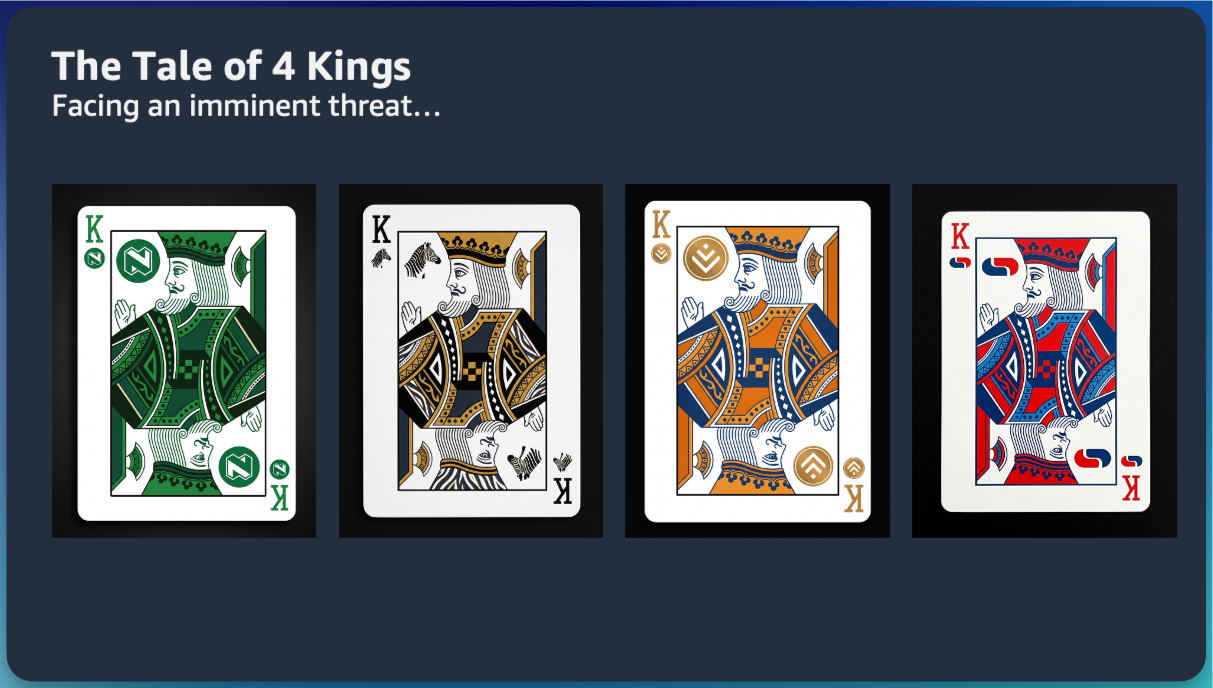
In a far-off land, there were 4 Kings who ruled their kingdoms and protected access to their precious resources by building walls around their kingdom. They successfully fended off many attacks, but were warned of a significant coming threat -
- The first built an army, but kept it for defence - not attack. The danger here is that the threat could arrive so quickly that it could overwhelm the kingdom before the army can be deployed.
- The second, ruler of a small kingdom, decided to provide weapons to its subjects, the majority of whom would not know the difference between a sword and an axe. The risk is that the weapons are distributed to a small group with only a few trained to use it.
- The third provided general protection for its citizens using a solution for the masses. The risk here is that the lowest-common-denominator approach could limit discovery (no pun intended) and production of innovative weapons.
- The fourth, possibly the wisest to the scale and severity of the danger, sought only to study the phenomenon rather than take immediate action. The inherent danger is that battles are fought with weapons - not words.
The largest, and possibly the most dangerous risk to all kingdoms, is that the kings did not choose to work together to prepare for the threat.
United, they could stand, divided they will fall...
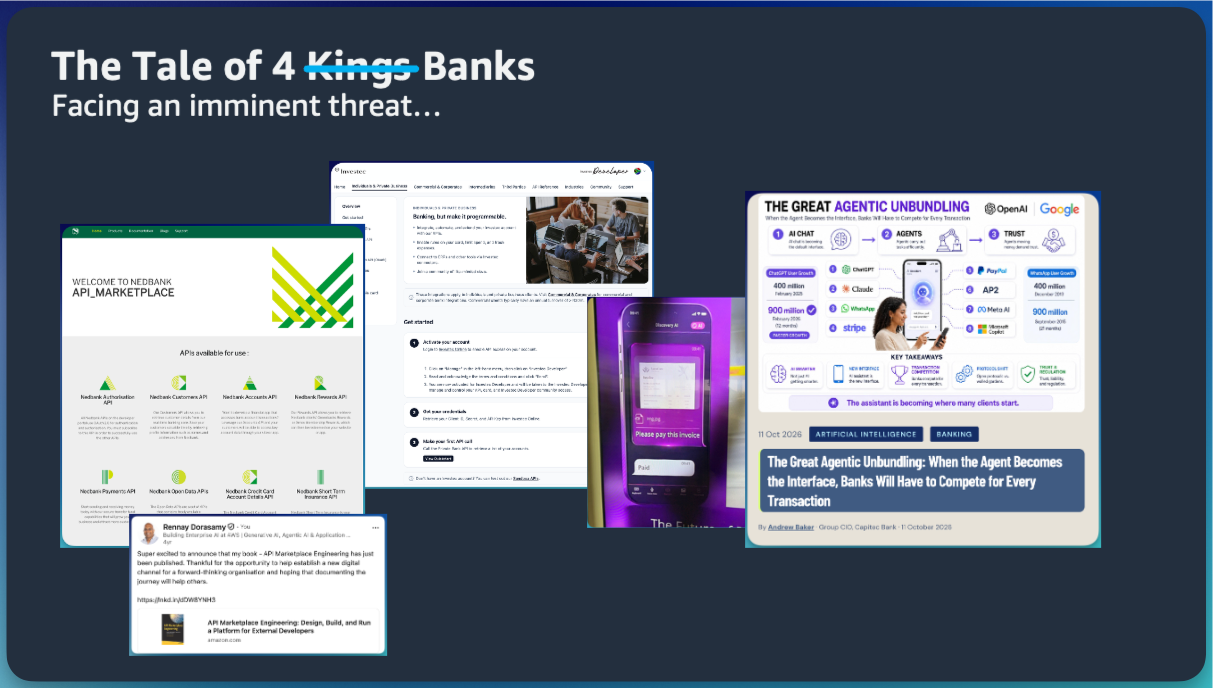
Bringing that metaphor home, payments are the precious resource that banks have jealously guarded. FinTechs were the previous threat. Now the danger is AI assistants: ChatGPT, Claude and Gemini - clear, present, and already at the gate. And here's my assessment of how some South African banks are positioned.
- Nedbank - this started almost 10 years ago, where we built Africa's first API Marketplace. If you're keen to know more about this, you can pick up a copy of my first book - API Marketplace Engineering (I'm pretty chuffed that this is listed on amazon.co.za - at time of writing)! The goal, when we set out, was to embrace future disruption in Financial Services by working with FinTechs.
- Investec - based on my understanding, Investec is the only bank in South Africa that actually has a programmable API that is easily accessible for developers. No arduous sign-ups, contact us, business-only, or limited functionality. Excellent developer support, strong community and can be found here. It also forms a critical part of my thesis - as it makes my proposed solution possible.
- Discovery - I've seen Ads during F1 races of an instruction to a chatbot of "Pay Mike R300" or "Pay invoice". Everyone who has had to pay an invoice has experienced the pain of having to capture the payment details and possibly approve it using two-factor auth. Every time I see the Ad, I think "this is not hard to do".
- Capitec - this was probably the tipping point for this post. After reading and re-reading Andrew Baker's (CIO of Capitec) article about Agentic interfaces, I realised that this is not some wild theory, but something that could actually happen. The premise is incredibly simple but equally impressive as it highlights the very real risk of banking institutions simply becoming a commodity as end users interact directly with ChatGPT/Claude/Gemini.
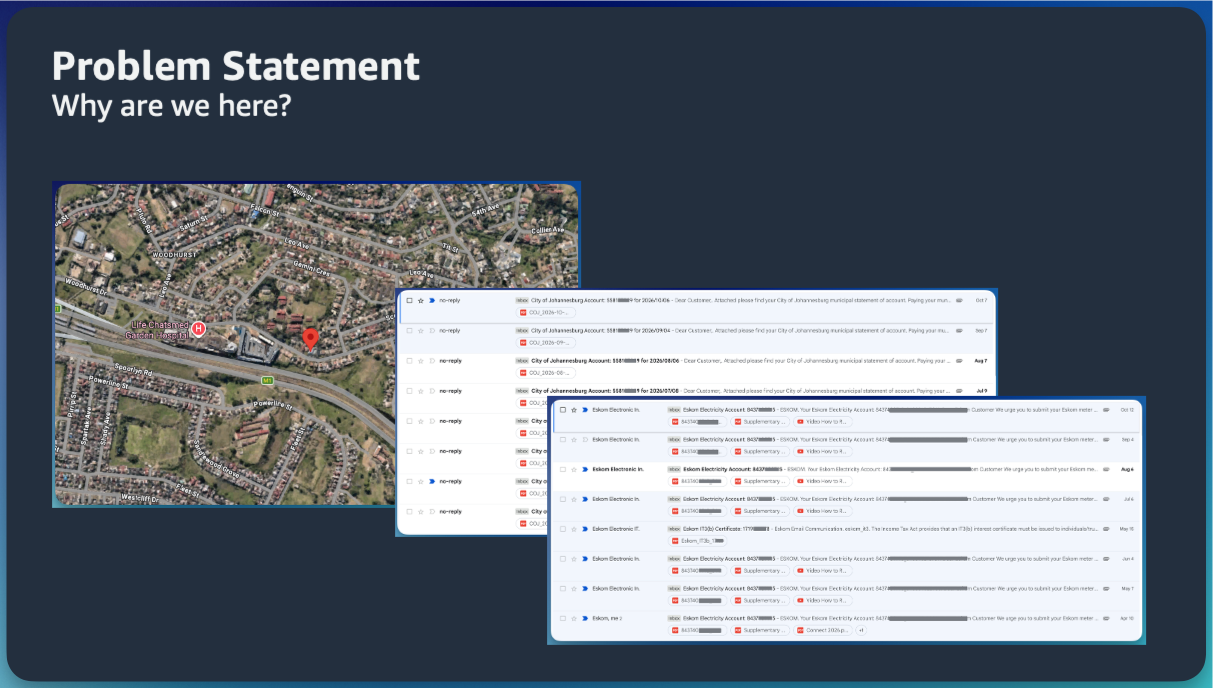
Ultimately, the problem I'm trying to address fills some human need. As a child, I was acutely aware of bill payments as it meant an administrative trip with my parents to the local municipal (aka "rent") office, bank or store, then waiting impatiently in line. It is far more convenient today as payments can be made electronically - captured via a banking website or an App. When an invoice hits my inbox, as it often does (for utility bills from the City of Johannesburg or Eskom or a service provider), it's on my mind until (i) it is paid (and confirmation sent), (ii) scheduled to be paid or (iii) written down on my to-do list so I don't forget to do (i) or (ii).
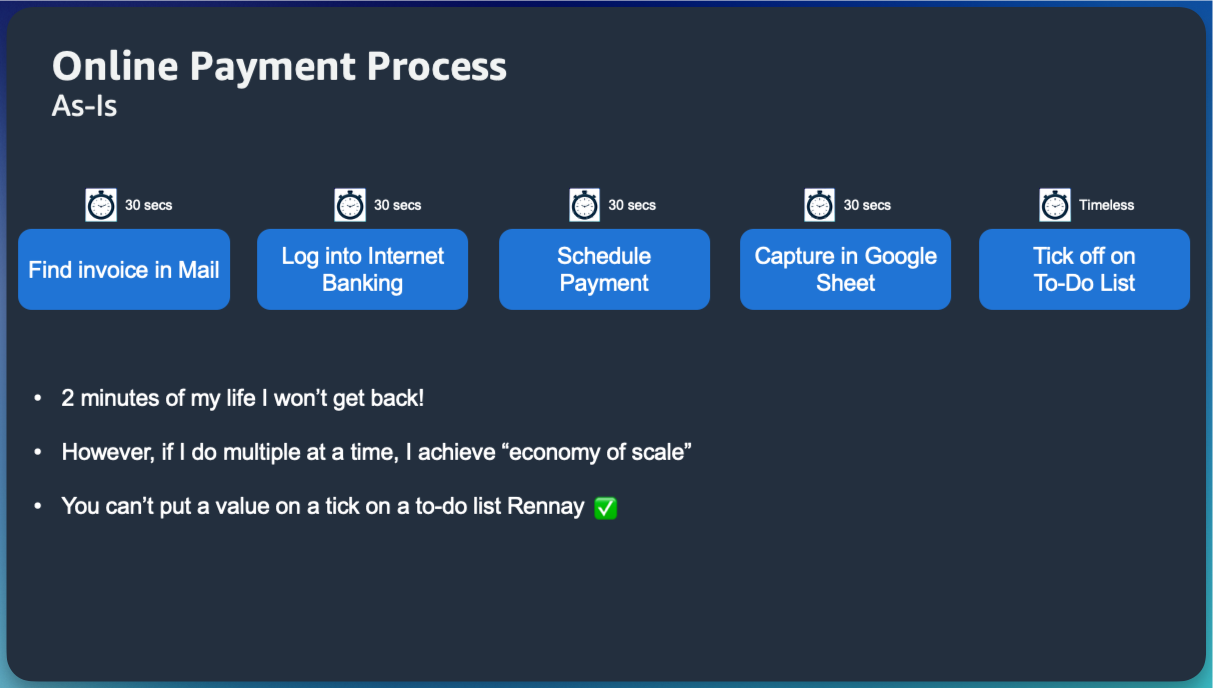
The challenge is that this is an arduous, often mind-numbing task that is necessary (in my mind) but also admin-intensive. For some bills, I also capture payments on a Google spreadsheet so I can track over time.
Admittedly, for an admin-oriented, aka "Dudley Do-Right" soul, this does provide some satisfaction as I get another tick on my to-do list. It is not the best use of my time, and invariably a new invoice comes in a few hours after I've cleared my list. However, given its importance, it is not something I'm readily willing to share or burden another member of the family with.
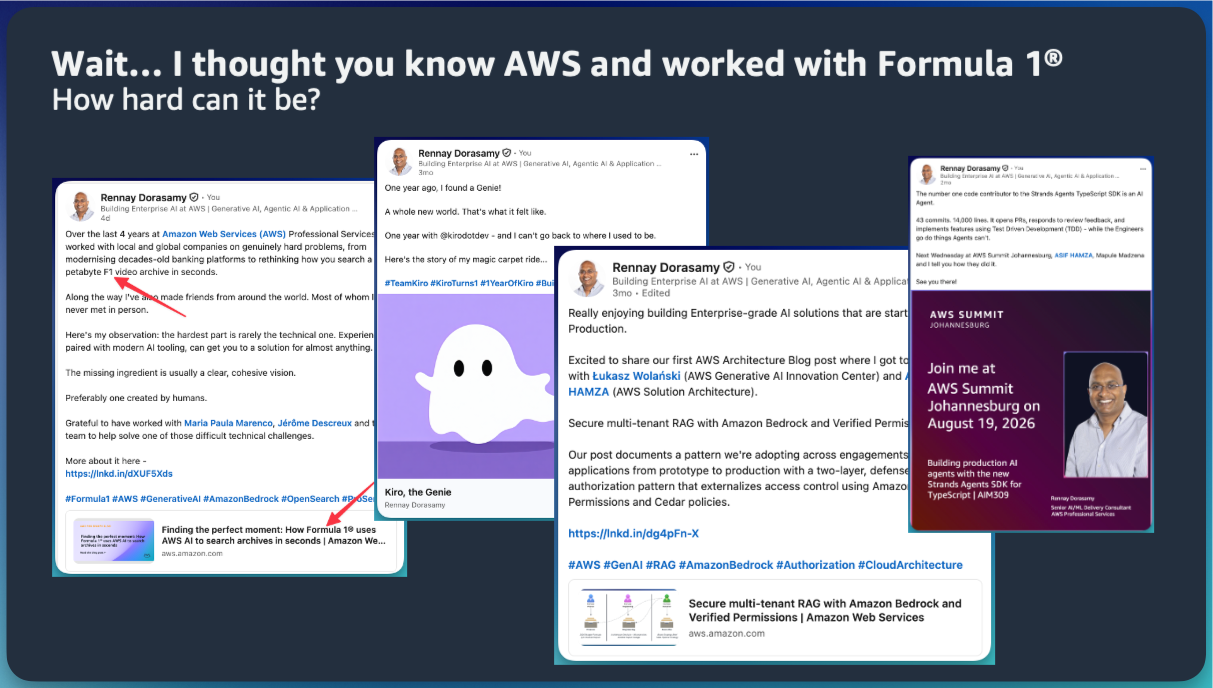
With years of experience in systems integration, technical architecture, application design and development, I have embarked on a quest to understand how AI will change how we will make payments in the future. In the next part, I address this challenge through a technical lens. I hope you will join me.
Note: I work at Amazon, but this is my own opinion.